







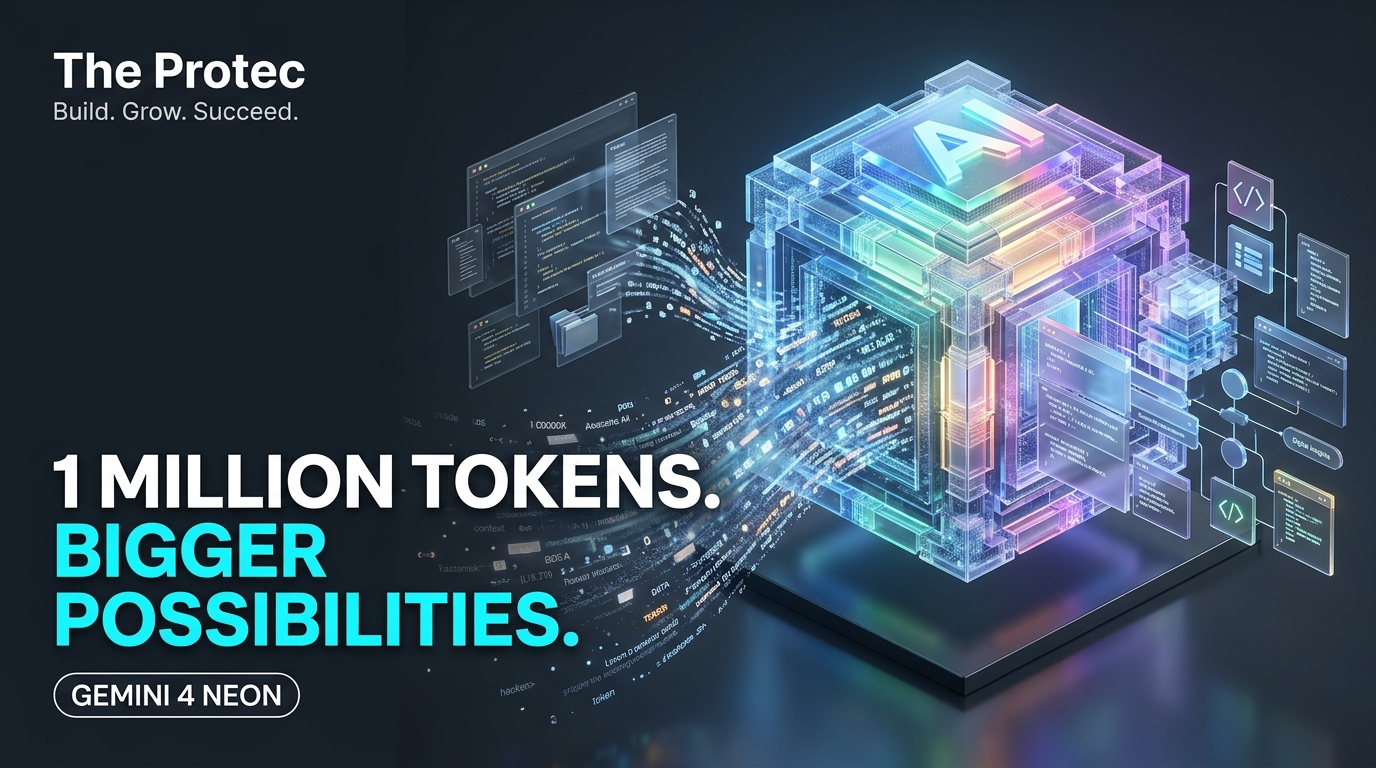
A model that can inspect an enormous codebase is useful only if it can find the right details, reason about their relationships and make reliable changes. That is the promise behind Gemini 4 Neon, Google’s new flagship AI model announced on November 18, 2026. Its headline features include a one-million-token context window, stronger coding performance and support for agentic workflows—putting it in direct competition with leading ChatGPT and Claude models.
For developers, the practical questions matter more than the launch language. Can Neon understand a repository rather than merely ingest it? How much will a long prompt cost? Does a Google AI Pro subscription include API use? And do Google’s Gemini 4 benchmarks translate into dependable performance on real software projects?
This guide separates Google’s stated capabilities from independently demonstrated results while examining where Neon may deliver genuine value.
What Google announced with Gemini 4 Neon
Google introduced Neon through its official Gemini 4 Neon announcement. The defining feature is support for as many as one million input tokens, accompanied by an emphasis on coding, tool use and long-running agentic tasks.
Neon is positioned as more than a conversational assistant. Google wants developers to use it for work involving large collections of connected information: analyzing repositories, tracing bugs across services, processing document archives and coordinating multi-step operations with external tools.
Three distinctions are important when evaluating the announcement:
- Capacity is not comprehension. A model may accept one million tokens without recalling every relevant detail equally well.
- First-party benchmarks are not independent validation. Google’s reported results describe its own testing conditions.
- Chat access and API access are separate products. A paid consumer subscription should not be assumed to include developer API credits.
What a one-million-token context window means
The Gemini 4 context window is the amount of input the model can consider during one request or active session. Tokens are pieces of text rather than words. The exact conversion varies by language, formatting and code, but one million tokens can represent several hundred thousand English words or a substantial software repository.
That does not mean every project should send one million tokens. Large prompts take longer to transmit and process, cost more through a metered API and can contain distracting material. Context engineering—selecting, organizing and labeling relevant information—remains essential.
Repository analysis
A development team could provide source files, dependency manifests, architecture notes, API schemas and selected issue history in one request. Neon could then map module relationships, identify duplicated logic or explain how authentication data travels through the application.
A better workflow than dumping an entire repository is to exclude generated files, binaries, vendored dependencies and irrelevant test fixtures. Add a directory map and ask the model to cite file paths and symbols for every conclusion. This makes its analysis easier to verify.
Debugging across multiple services
Complex failures often span application code, infrastructure configuration, logs and database queries. A long-context model can examine these materials together. For example, a developer might submit an error trace, deployment manifest, recent commit diff and relevant service code, then ask Neon to build a timeline and rank possible causes.
The output is still a hypothesis, not proof. Teams should require reproducible tests before accepting a proposed fix, particularly when the model suggests changing security controls, migrations or production infrastructure.
Document processing
The same capacity can support analysis of contracts, research papers, policy libraries and technical manuals. Neon can compare terminology, locate contradictions or produce a structured index across many documents. For higher-stakes work, prompts should request page-level citations and separate extracted facts from interpretation.
Long-running tasks
Agentic workflows allow a model to plan steps, call approved tools, inspect results and continue working. A coding agent could review an issue, locate affected files, write a patch, run tests and revise the patch after failures. Long context helps preserve the issue requirements, repository structure and earlier tool output throughout that process.
It does not eliminate operational safeguards. Agents need limits on file access, shell commands, network use, spending and execution time. Human approval should remain mandatory before deployment or destructive actions.
Gemini 4 coding: where Neon could be most useful
Google is promoting Gemini 4 coding as a central strength. The most promising use cases are tasks that combine code generation with broad project understanding rather than isolated autocomplete.
- Explaining an unfamiliar repository and creating onboarding documentation.
- Tracing an interface change through callers, tests and documentation.
- Planning framework upgrades while identifying deprecated dependencies.
- Reviewing pull requests for inconsistencies with project conventions.
- Generating tests from existing behavior and issue requirements.
- Investigating failures that involve source code, logs and configuration.
Neon should not be judged solely by whether it produces compilable code. Useful evaluations should measure whether a patch solves the requested problem, avoids unrelated changes, passes hidden tests and remains maintainable. Security-sensitive code deserves additional static analysis and human review.
Google Antigravity and agentic development
Google Antigravity represents the workflow layer around Google’s coding models rather than a replacement name for Neon. Where available, it can provide the environment in which an agent examines a project, edits files and uses development tools. Neon supplies the underlying reasoning and generation capability.
This distinction affects purchasing decisions. A team may have access to the model through an API without receiving every Antigravity interface feature. Conversely, a subscription product may impose task, usage or regional limits that differ from API quotas. Organizations should evaluate the complete workflow—not just the model name—including audit logs, permissions, data retention and integration with existing repositories.
Gemini 4 pricing and API cost calculations
Gemini API pricing must be checked against Google’s current pricing page or developer console because rates can vary by input length, output volume, caching, batch processing and platform. The launch announcement is evidence of the model’s introduction, but it should not be treated as a permanent price sheet.
The basic calculation is:
Input cost = input tokens ÷ 1,000,000 × input rate.
Output cost = output tokens ÷ 1,000,000 × output rate.
Suppose a repository request contains 600,000 input tokens and asks for 20,000 output tokens. If the console labels the applicable rates as I dollars per million input tokens and O dollars per million output tokens, the request costs 0.6 × I + 0.02 × O. This formula is more reliable than inserting an unverified price that may differ by tier or change after publication.
Costs can grow quickly in an agent loop because every step may resend accumulated context. Ten turns do not necessarily cost the same as one turn. Prompt caching, if supported for the selected endpoint, can reduce the cost of repeatedly supplied repository content. Retrieval can also select only the files needed for each step.
Google AI Pro versus API billing
Paid Google AI Pro access may unlock Neon in supported Google interfaces, subject to account, region and usage restrictions. It should not be interpreted as unlimited API access. Developers generally need a separate Google Cloud or Gemini API billing arrangement, and enterprise use may require project-level permissions and quotas.
Before deployment, confirm the exact model identifier, rate limits, data-handling terms and whether requests are eligible for caching or batch discounts. Workspace administrators may also restrict access even when an individual user has a qualifying subscription.
Gemini 4 Neon vs ChatGPT
The Gemini 4 Neon vs ChatGPT decision depends on the specific OpenAI model and product tier being compared. ChatGPT is an application containing tools, memory and integrations; Neon is a model that can appear in Google products and APIs. Comparing product names without matching tools and settings can produce misleading conclusions.
Neon’s one-million-token capacity is attractive for large repositories and document collections. ChatGPT may be preferable when a team’s established workflow depends on OpenAI-compatible tooling, particular agent features or existing enterprise controls. In practice, teams should run the same private task set on both systems and measure correctness, latency, tool failures and total cost.
Gemini 4 vs Claude
Gemini 4 vs Claude is similarly workload-dependent. Anthropic’s Claude family has built a strong reputation among developers for code explanation, editing and instruction following. Neon answers with a very large context window and deeper integration across Google’s AI and cloud ecosystem.
A fair test should include complete feature requests, difficult bug reports and multi-file refactors—not just short algorithm exercises. Track how often each model identifies the correct files, introduces regressions, fabricates APIs or needs human correction. The most valuable model is the one that completes the whole task reliably, not the one that writes the most confident explanation.
How to interpret Gemini 4 benchmarks
Google’s published Gemini 4 benchmarks are first-party results. They can be informative, especially when Google provides model versions, prompts, tool settings and scoring methods, but they are not the same as independent replication.
Relevant independent evaluations for AI coding models include SWE-bench Verified for repository-level issue resolution, Terminal-Bench for command-line agent tasks and LiveCodeBench for less contaminated coding problems. Long-context testing should also include retrieval tasks in which crucial facts are distributed throughout realistic documents.
Because Neon launched only on November 18, independent leaderboards and real-world evaluations may lag the announcement. Readers should avoid treating missing third-party results as either proof of superiority or evidence of weakness. The responsible approach is to wait for reproducible evaluations and test Neon against an organization’s own representative workload. Independent model-analysis services such as Artificial Analysis can be useful once they publish results for the exact production model.
Limitations developers should expect
- Long context can dilute attention: Relevant details may be overlooked amid repetitive or unrelated material.
- Hallucinations remain possible: Neon may invent functions, dependencies, citations or test outcomes.
- Latency can increase: Very large prompts and multi-step agents take longer than focused requests.
- Costs are workload-sensitive: Repeated context and verbose output can make agent loops expensive.
- Tool use adds risk: Incorrect commands can alter files, expose secrets or damage an environment.
- Availability may vary: Accounts, regions, quotas and Google Cloud configurations can affect access.
Who should consider using Neon?
Gemini 4 Neon is most compelling for developers and analysts whose tasks are genuinely constrained by context size. That includes teams maintaining large repositories, investigating cross-service failures, reviewing extensive technical records or building agents that must preserve state through many steps.
Smaller projects may not benefit enough to justify larger prompts or premium access. A faster, less expensive model paired with retrieval can be more efficient for routine support, summarization and single-file coding.
The best adoption path is a controlled pilot. Select 20 to 50 representative tasks, define success criteria, record token use and compare Neon with the ChatGPT or Claude model already used by the team. Include failed tasks, because reliability and recovery matter as much as peak benchmark performance.
Frequently asked questions
Does Gemini 4 Neon really support one million tokens?
Google’s announcement states that Neon supports a one-million-token context window. That describes maximum input capacity, not a guarantee that the model will recall or reason perfectly over every token.
Is Gemini 4 Neon included with Google AI Pro?
Access can depend on region, account type and product limits. Even when Neon is available through Google AI Pro, API calls are normally governed by separate developer billing, quotas and terms. Check the account interface before subscribing.
Is Neon better than ChatGPT or Claude for coding?
No universal winner can be established from a launch announcement. Neon may have an advantage for context-heavy work, while particular ChatGPT or Claude models may perform better on other coding and agent tasks. Independent tests and private workload evaluations are more useful than vendor averages.
Should developers send an entire repository in every prompt?
Usually not. Remove generated and irrelevant files, provide a repository map and use retrieval or caching where available. Focused context generally improves speed, cost and signal quality while retaining the option to load more files when needed.
Can Neon safely run coding tasks without supervision?
It can automate parts of a workflow, but unsupervised access to production systems is risky. Use isolated environments, restricted credentials, command allowlists, spending limits and human approval before merging or deploying changes.