









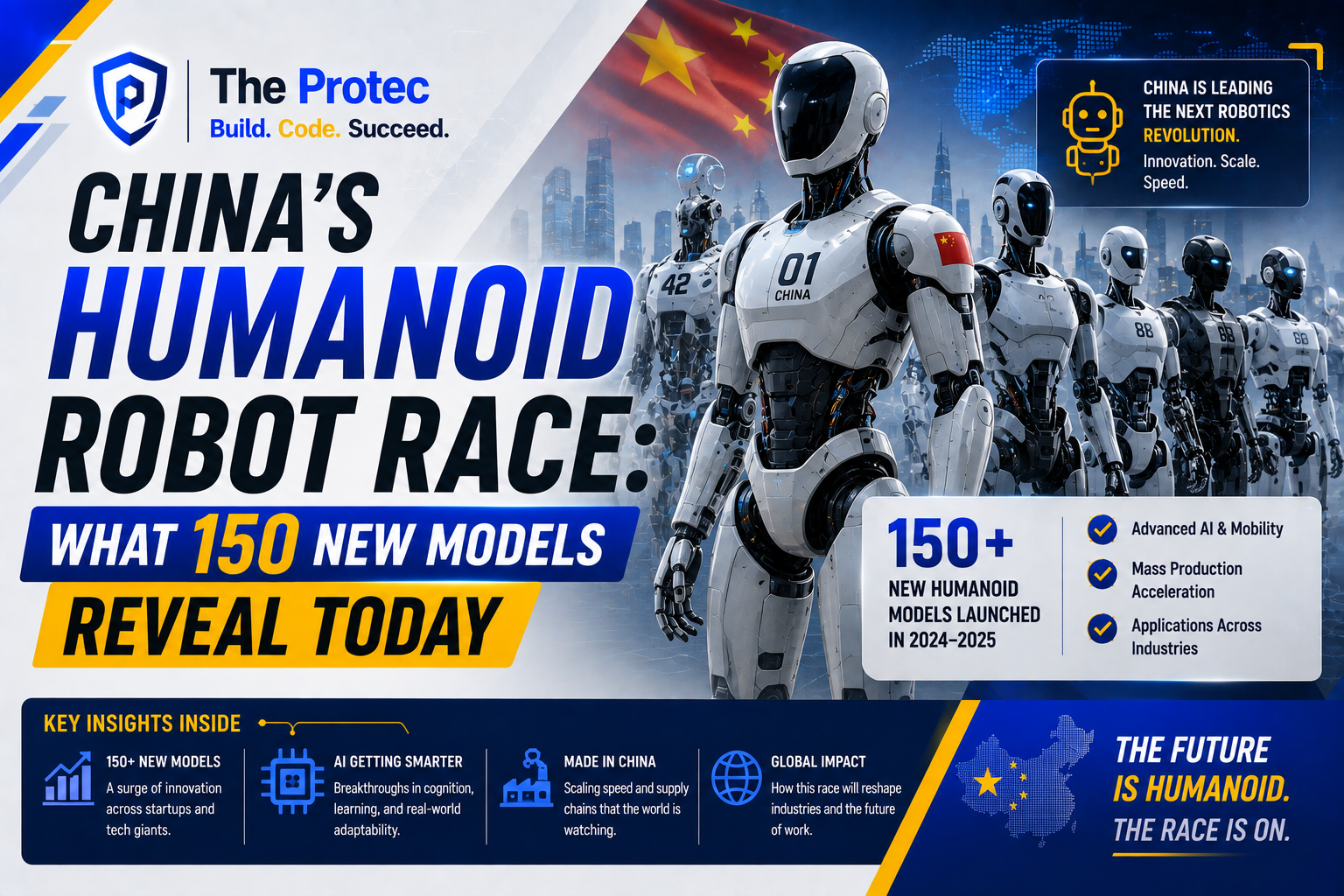
China’s humanoid-robot market has moved from a collection of ambitious prototypes into a full-scale industrial race. As of August 2026, roughly 150 new robots, model variants, and commercial platforms have emerged from Chinese manufacturers during the latest development cycle. Not all will reach mass production, but their collective significance is difficult to ignore.
The surge shows how quickly China can connect artificial intelligence research with component suppliers, factories, electric-vehicle engineering, and government-backed commercialization programs. It also reveals a strategic shift: developers are no longer building humanoids solely to demonstrate walking, dancing, or object manipulation. They are increasingly designing machines for assembly lines, warehouses, retail environments, laboratories, and public services.
That does not mean general-purpose robot workers have arrived. Reliability, dexterity, safety, battery life, and economic return remain serious constraints. Yet the expanding field of China humanoid robots suggests that practical deployment is becoming less of a distant research goal and more of an engineering and manufacturing challenge.
What the 150 New Robots Actually Represent
The headline figure needs context. The approximately 150 robots include newly announced platforms, upgraded generations, specialized variants, pilot-production machines, and models presented for specific industrial tasks. They are not necessarily 150 completely independent architectures, nor are all of them available to ordinary buyers.
Even with that caveat, the volume matters. A large product pipeline allows companies to test different body sizes, joint systems, hand designs, sensors, control software, and target markets simultaneously. It also increases the likelihood that commercially useful designs will emerge through iteration rather than through a single technological breakthrough.
The diversity is especially revealing. China’s ecosystem now includes full-size factory humanoids, compact research robots, wheeled humanoids, service machines, highly agile demonstration platforms, and upper-body systems built for stationary work. Some prioritize lifting capacity, while others focus on balance, mobility, dexterous manipulation, or affordable access for AI developers.
This is less like a race to create one perfect android and more like the early development of the automotive industry. Manufacturers are exploring multiple configurations while standards, supply chains, and customer expectations are still taking shape.
Why the China Robotics Industry Can Move So Quickly
China’s biggest advantage is not a single AI model or robotics laboratory. It is the proximity of nearly every capability required to turn a prototype into a repeatable product. Robot developers can source motors, reducers, batteries, cameras, force sensors, controllers, machined parts, and electronics from dense manufacturing networks.
The country’s electric-vehicle sector adds another layer of expertise. EV companies understand batteries, power electronics, real-time control, thermal management, automated manufacturing, and supply-chain cost reduction. Several automakers and automotive suppliers have transferred engineers, software, and production methods into humanoid projects.
China also operates the world’s largest industrial-robot market. Data from the International Federation of Robotics consistently shows the country’s dominant role in annual industrial-robot installations. That existing automation base gives humanoid companies access to experienced integrators and factories that are already comfortable testing robotic systems.
Three structural strengths are accelerating development:
- Component localization: Domestic production of actuators, controllers, sensors, batteries, and mechanical parts can reduce both cost and lead time.
- Fast design iteration: Close links between engineering teams and suppliers make it easier to modify joints, hands, frames, and electronics between production runs.
- Real deployment environments: Manufacturers can test robots in electronics plants, vehicle factories, warehouses, and logistics centers rather than relying exclusively on laboratories.
This manufacturing depth does not guarantee quality. High-performance reducers, durable actuators, tactile sensors, and precision components remain difficult to produce consistently. However, the ecosystem allows weaknesses to be identified and addressed at unusual speed.
Embodied AI Is Becoming the Real Battleground
Mechanical engineering once dominated humanoid-robot comparisons. Walking stability, speed, payload, and joint count were the most visible measures of progress. Those capabilities still matter, but the competition among humanoid robots 2026 has increasingly shifted toward embodied intelligence: the ability to perceive an environment, understand instructions, plan actions, and adapt when conditions change.
Developers are combining vision-language-action models with imitation learning, reinforcement learning, motion-planning systems, and conventional control software. A worker can demonstrate a task through teleoperation, after which the robot learns from recorded video, joint positions, force readings, and corrective actions. Simulated environments then generate additional training examples before the behavior is tested in a physical workspace.
China’s large labor-intensive manufacturing base offers a valuable source of task data. Repetitive activities such as parts sorting, material handling, machine tending, quality inspection, and bin picking can be recorded across many environments. Fleets of robots can also share failure cases, allowing an improvement discovered at one site to benefit machines elsewhere.
The central problem is that physical-world data is expensive. Internet-scale AI can learn from enormous collections of text and images, but a robot must understand friction, weight, balance, occlusion, deformable objects, and human movement. A small error can damage equipment or injure someone. For this reason, the strongest systems use layered control: AI handles interpretation and planning, while deterministic safety systems enforce limits.
The winners may therefore be companies that build the best data engines rather than the most visually impressive machines. Hardware generates experience, experience improves AI, and better AI makes the hardware more useful. China’s growing robot fleet could turn that cycle into a significant competitive advantage.
Which Companies and Platforms Are Leading?
The China robotics industry includes established automation companies, well-funded startups, automakers, university spinouts, and consumer-technology groups. Unitree has attracted global attention with the H1 and lower-cost G1, combining dynamic mobility with a platform that researchers and developers can program. UBTECH has concentrated heavily on industrial deployment through its Walker series, including trials in automotive manufacturing.
Fourier Intelligence has developed the GR family while drawing on experience in rehabilitation robotics. AgiBot has pursued multiple robot types and a broader embodied-AI strategy. RobotEra, EngineAI, LimX Dynamics, Leju Robotics, Galbot, and other emerging companies are testing different combinations of mobility, manipulation, pricing, and industry specialization. Automakers such as XPeng have also treated humanoids as an extension of their work in autonomous systems and intelligent manufacturing.
It is too early to produce a definitive ranking of the best humanoid robots. The answer depends on the task. A research institution may favor affordability, an open software interface, and easy maintenance. A car factory needs uptime, payload, repeatability, safety certification, and integration with production software. A warehouse may prefer a wheeled base because it is more efficient than legs on smooth floors.
Meaningful comparisons should examine:
- Successful task completion over an entire shift, not a short demonstration
- Mean time between failures and speed of repair
- Useful payload at realistic arm extension
- Hand durability, grip control, and tactile feedback
- Battery runtime and charging strategy
- Ease of training the robot for a new task
- Total operating cost relative to existing automation
These measures are less dramatic than running speed or backflips, but they determine whether a customer orders one robot for publicity or hundreds for daily work.
Are Humanoid Robots Ready for Commercial Deployment?
For tightly controlled jobs, the answer is increasingly yes. For unrestricted general labor, it remains no. Chinese humanoids are approaching practical use in workflows where the environment is structured, the task can be supervised, and occasional human intervention is acceptable.
Factories are the leading opportunity because layouts, tools, and processes can be adjusted for robots. Early tasks include moving containers, loading parts, scanning components, feeding machines, and performing repetitive inspections. These jobs provide clearer economic value than placing an autonomous humanoid in an unpredictable home.
Commercial deployment is likely to advance through supervised autonomy. One operator may monitor several robots, step in remotely when a machine encounters an unfamiliar situation, and add the resolution to the training dataset. As the intervention rate falls, the economics improve.
Leasing and robotics-as-a-service models can also reduce customer risk. Instead of purchasing an expensive machine with uncertain utilization, a factory can pay for hours worked, completed tasks, or a monthly service package. The supplier remains responsible for maintenance and software updates.
Humanoid form is not always the most efficient answer. Fixed robot arms are faster for repetitive operations, while autonomous mobile robots move goods with less energy. Humanoids make sense when a site was designed around human reach, tools, stairs, doorways, and workstations—and when redesigning that site would cost more than deploying an adaptable robot.
The Obstacles Hidden Behind Impressive Demonstrations
Short videos can conceal the hardest commercial problems. A robot may complete a carefully rehearsed task once while still being unable to perform it thousands of times. Reliable autonomy requires handling misplaced objects, changing lighting, worn tools, people entering the workspace, network interruptions, and gradual mechanical degradation.
Dexterous hands remain a major bottleneck. Human hands combine strength, sensitivity, compliance, and remarkable durability. Robotic hands that offer many degrees of freedom are often expensive and fragile, while simpler grippers cannot perform enough tasks to justify a humanoid body.
Energy efficiency is another constraint. Walking, balancing, computing, and moving multiple joints consume substantial power. Battery swaps and charging breaks reduce utilization, and larger batteries add weight. Heat management becomes difficult when powerful actuators and AI computers operate inside a compact frame.
Safety and accountability will also shape adoption. Companies need clear rules for risk assessment, emergency stops, cybersecurity, data collection, remote access, and responsibility when autonomous actions cause damage. Export markets may impose different standards, making compliance as important as raw performance.
What China’s Robot Surge Means for the Global Market
The wave of 150 new robots indicates that humanoid development is entering a phase of aggressive experimentation and cost competition. Many platforms will disappear or merge, but their components, engineers, datasets, and manufacturing lessons will remain within the ecosystem.
China could exert the same downward pressure on robot prices that it brought to drones, batteries, solar equipment, and electric vehicles. Lower prices would expand access for universities, software developers, and smaller manufacturers, creating more applications and training data. International competitors may respond by focusing on premium hardware, proprietary AI, safety certification, or specialized industry partnerships.
The most important milestone will not be another dramatic launch. It will be evidence that a fleet can perform useful work for months with predictable costs and declining human intervention. Watch repeat orders, operating hours, task-success rates, service networks, and production yield rather than announcement totals alone.
FAQ: China Humanoid Robots
Why are so many humanoid robots being developed in China?
China combines strong robotics research with dense electronics, automotive, battery, and precision-manufacturing supply chains. Government support, abundant factory test sites, and competition among startups and major technology companies further accelerate product development.
What are the best humanoid robots from China?
There is no universal winner. Unitree platforms are prominent for mobility and developer access, UBTECH emphasizes industrial applications, and companies such as Fourier Intelligence, AgiBot, LimX Dynamics, and RobotEra offer different strengths. The best choice depends on reliability, task requirements, software access, support, and total cost.
Will humanoid robots replace factory workers soon?
Broad replacement is unlikely in the near term. Humanoids will first handle repetitive, hazardous, or ergonomically difficult tasks in structured environments. Most deployments will involve collaboration with people, remote supervision, and gradual expansion as reliability improves.
Are 150 new robots evidence of a market bubble?
The number reflects both genuine progress and intense promotional competition. Some projects will fail because they lack reliable hardware, differentiated software, or paying customers. However, the underlying investment in components, embodied AI, manufacturing capacity, and field testing is likely to accelerate the industry even if consolidation follows.
What should businesses monitor next?
Businesses should track repeat customer orders, verified deployment hours, intervention rates, maintenance costs, safety certifications, and task-level productivity. Those indicators reveal commercial maturity far more accurately than prototype videos or the number of models announced.